
As businesses and developers demand faster, more reliable hosting solutions, storage technology has become a key factor in server performance. While SSD VPS hosting has long been considered a major upgrade over traditional hard drives, newer technologies such as NVMe are redefining what high-performance hosting looks like.
Many users now ask, why is NVMe VPS faster than SSD VPS? The answer lies in how these storage technologies are designed and how they interact with server hardware. NVMe VPS hosting offers significantly improved speed, lower latency, and better overall performance compared to traditional SSD VPS hosting.
Providers like HostingSource leverage advanced storage technologies such as NVMe to deliver high-performance VPS hosting environments that support modern applications, websites, and business operations.
What Is SSD VPS Hosting
SSD VPS hosting uses solid-state drives (SSDs) as the primary storage medium. Unlike traditional hard disk drives (HDDs), SSDs do not have moving parts and store data using flash memory. This allows for faster data access, improved reliability, and better performance.
SSD VPS hosting is widely used because it offers a significant performance boost compared to HDD-based hosting. It provides faster website loading times, improved database performance, and better responsiveness for applications.
However, while SSDs are fast, they are still limited by the interface they use to communicate with the server.
What Is NVMe VPS Hosting?
NVMe VPS hosting uses Non-Volatile Memory Express (NVMe) storage, which is a newer and more advanced storage protocol designed specifically for high-speed data transfer.
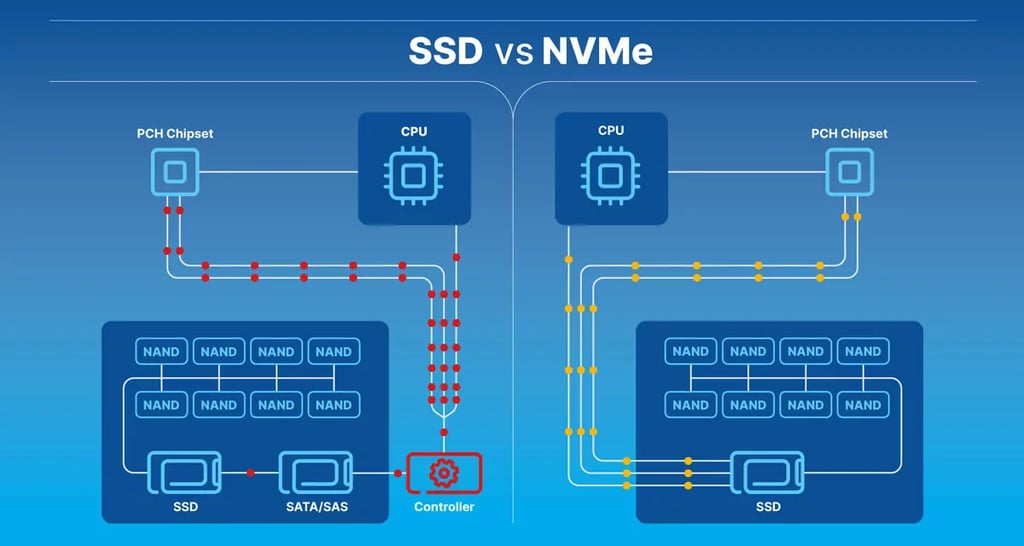
Unlike traditional SSDs that use SATA interfaces, NVMe drives connect directly to the server’s PCIe (Peripheral Component Interconnect Express) lanes. This direct connection allows NVMe storage to bypass many of the limitations of older storage technologies.
As a result, NVMe VPS hosting delivers faster read and write speeds, lower latency, and improved performance for data-intensive applications.
Why Is NVMe VPS Faster Than SSD VPS?
The main reason NVMe VPS is faster than SSD VPS lies in the difference between their underlying technologies.
1. Faster Data Transfer Speeds
NVMe drives can handle significantly higher data transfer rates compared to SATA-based SSDs. While traditional SSDs are limited by SATA bandwidth, NVMe drives use PCIe connections, allowing for much higher throughput.
This results in faster file transfers, quicker database queries, and improved overall server performance.
2. Lower Latency
Latency refers to the time it takes for data to travel between storage and the processor. NVMe storage is designed to minimize latency by reducing the number of steps required to process data.
Lower latency means faster response times, which is especially important for applications that require real-time processing.
3. Parallel Processing Capability
NVMe technology supports multiple input/output (I/O) queues, allowing it to handle thousands of simultaneous operations. In contrast, traditional SSDs are limited in how many operations they can process at once.
This makes NVMe VPS hosting ideal for high-traffic websites and applications that require handling multiple requests simultaneously.
4. Direct Connection to CPU
NVMe drives connect directly to the CPU via PCIe lanes, bypassing the bottlenecks associated with older storage interfaces. This direct communication improves efficiency and speed.
5. Optimized for Modern Workloads
NVMe technology is designed for modern computing environments, including cloud hosting, virtualization, and high-performance applications. It delivers consistent performance under heavy workloads.
HostingSource utilizes NVMe-powered VPS environments to provide faster and more efficient hosting solutions for businesses.
NVMe VPS vs SSD VPS: Key Differences
| Feature | NVMe VPS | SSD VPS |
|---|---|---|
| Interface | PCIe | SATA |
| Speed | Very High | Moderate |
| Latency | Low | Higher |
| I/O Operations | High | Limited |
| Performance | Optimized for high workloads | Suitable for standard workloads |
NVMe VPS hosting clearly outperforms SSD VPS hosting in terms of speed and efficiency, making it a better choice for performance-driven applications.
Performance Benefits of NVMe VPS Hosting
The advantages of NVMe VPS hosting go beyond technical specifications. They directly impact real-world performance.
Faster Website Loading Times
Websites hosted on NVMe VPS load faster, improving user experience and SEO rankings.
Improved Database Performance
Applications that rely on databases benefit from faster query execution and data processing.
Better Application Responsiveness
Lower latency ensures that applications respond quickly to user interactions.
Enhanced Multitasking
NVMe VPS can handle multiple processes simultaneously without performance degradation.
HostingSource focuses on delivering NVMe VPS hosting solutions that provide these performance benefits for businesses.
Use Cases for NVMe VPS Hosting
NVMe VPS hosting is ideal for applications that require high performance and fast data processing.
Ecommerce Platforms
Online stores benefit from faster page loads and smoother checkout experiences.
High-Traffic Websites
Websites with large volumes of visitors require fast and reliable hosting infrastructure.
SaaS Applications
Software platforms need consistent performance and low latency for user interactions.
Database-Driven Applications
Applications that rely heavily on databases benefit from faster data access.
Development Environments
Developers use NVMe VPS hosting for testing and deploying applications efficiently.
How HostingSource Supports NVMe VPS Hosting
HostingSource offers VPS hosting solutions powered by NVMe storage, designed to deliver high performance and reliability. By leveraging modern hardware and advanced virtualization technology, HostingSource provides hosting environments that support fast data processing and scalable infrastructure.
The platform focuses on delivering consistent performance, low latency, and flexible configurations. This ensures businesses can run applications, websites, and services without performance limitations.
HostingSource’s NVMe VPS hosting solutions are designed to meet the needs of modern digital operations.
Is NVMe VPS Worth It?
For businesses and developers looking for faster performance, NVMe VPS hosting is a worthwhile investment. While it may cost slightly more than traditional SSD VPS hosting, the performance improvements often justify the price difference.
Faster load times, improved application performance, and better scalability contribute to higher efficiency and better user experiences. For many businesses, these benefits translate into increased conversions and improved customer satisfaction.
Conclusion
Understanding why NVMe VPS is faster than SSD VPS comes down to the technology behind storage systems. NVMe drives use advanced interfaces, lower latency, and parallel processing capabilities to deliver significantly better performance.
As digital demands continue to grow, choosing the right hosting infrastructure becomes essential. NVMe VPS hosting provides the speed, efficiency, and scalability required for modern applications and websites.
Providers like HostingSource offer NVMe VPS hosting solutions that combine high performance with reliable infrastructure, helping businesses stay competitive in a fast-paced digital environment.
Frequently Asked Questions About NVMe VPS vs SSD VPS
Why is NVMe faster than SSD?
NVMe uses PCIe connections and supports parallel processing, resulting in faster data transfer and lower latency compared to SATA-based SSDs.
Is NVMe VPS better for websites?
Yes, NVMe VPS provides faster load times and better performance, especially for high-traffic websites.
Does NVMe VPS improve SEO?
Faster website speed can improve user experience and indirectly contribute to better search engine rankings.
Is NVMe VPS more expensive than SSD VPS?
NVMe VPS may cost slightly more, but the performance benefits often justify the investment.